Ask anyone in medical school, and they’ll tell you that it isn’t the actual content that’s hard.
“Then what’s hard?” you might ask.
It’s the sheer amount of information that you are expected to retain. Luckily, we have three effective study strategies for medical school that you can start using immediately to help you retain information (and actually work)!
Three Effective Study Strategies for Medical School
Have you ever crammed the night before a test? I think we probably all have, maybe more than we’d like to admit. In the past, cramming may have been your only option when you were short on time. Maybe you were taking a heavy courseload, working a job or two, and juggling other personal obligations. You may have even seen positive results after cramming for a test.
Cramming can be useful for short-term retrieval of information that you won’t need to remember and use later, like remembering how to conjugate pluperfect verbs in Latin or remembering the state capitals. Now that you’re in med school, however, you’re learning material that you’ll need to be able to remember beyond the test, which means your days of successful cramming are history.
1. Spaced Practice
Spacing out your study sessions and revisiting concepts more than once improves remembering. The things you are learning in med school are knowledge and skills you will use in the future to solve problems and care for patients which means cramming won’t help you.
Spaced practice is a technique that involves reviewing information and practicing problems at optimal intervals. You review a difficult concept frequently and space this out over time until you can remember the information on your own and are easily able to recall it.
This reminds us: spaced practice is hard to talk about without also talking about retrieval practice. Our second strategy recommendation is retrieval practice.
2. Retrieval Practice
Practicing recall, or trying to retrieve information from memory, is a critical part of studying. This is the actual “practice,” or putting your knowledge into action. You’re practicing what you will do when caring for patients in a clinic or on an exam.
You may be thinking that you shouldn’t have to memorize anything because you’ll be able to look up information while caring for patients. You’re correct: for the most part, you will be able to look stuff up. How long do you think it will take for you to look up each sign and symptom a patient presents, then the etiology, pathophysiology, contraindications…. You see where we’re going with this? Then, once you look all that up, analyze and synthesize the info, determine if any diagnostic studies and labs are needed, come up with some differentials… I think you get the point.
You need to be able to retrieve and use the knowledge and skills you’re learning in med school by using (practicing) retrieval and applying the knowledge and skills around those concepts. Spaced practice and retrieval practice are important practices for learning and retaining information for later use.
To help you space out your retrieval practice, planning your study sessions ahead of time will set you up for success.
3. Planning Your Study Schedule
The third strategy recommendation is scheduling. Instead of looking to see what is due next, plan out your study schedule ahead of time. Knowing what you need to learn and when you need to learn it will help ensure you engage in spaced and retrieval practice. Planning takes some time upfront, however it saves you time in the end. You won’t be wasting time trying to decide what to study each day, you’ll just follow what you planned.
Ebbinghaus’ Forgetting Curve shows how quickly and how much we forget new material. From the diagram below, you’ll see that you’re most likely to forget information right after you’ve learned it. To combat this, Ebbinghaus said to review information at close (optimal) intervals.
Surgery is not for everybody. I can say with certainty that it wasn’t my favorite rotation. Our introduction to surgery was the surgical clerkship director stating that we should only “go into surgery only if you can’t see yourself doing absolutely anything else.” That was sound advice.
Regardless of which field you enter, you must complete medical school, including your surgical rotation. Even if you’re not planning to go into surgery, it’s important to learn the situations in which surgical consults are necessary. Learning how to function and not offend anyone in the OR is a skill that will serve you in more fields than you think. You also get more opportunities to work with your hands!
The day in the life of a medical student on a surgical rotation differs drastically from that on a medicine rotation. Even among different surgical subspecialties, the day-to-day varies greatly. By the end of your surgery rotation, however, you’ll have stronger life skills, resilience, and empathy for your surgical colleagues.
Put your shelf exam knowledge to the test with this FREE shelf exam practice quiz of the most commonly missed shelf questions from the Rosh Review Shelf Exam Qbanks (one for each specialty)! Each question includes a detailed explanation and visuals to help you retain anything you may have missed. How many questions can you get?
My Experience as a Medical Student: Surgery Rotation
I chose to describe a “day in the life” from one of my hardest surgical rotations when I was a medical student: transplant surgery. Even though I did not pursue a surgical residency, this two-week rotation had a profound effect on me. It taught me how to have perspective, adapt, and even thrive in unfamiliar and stressful situations.
Mornings
My least favorite part of the day—waking up. It’s not so bad on a regular day. It’s just that on this rotation, I have to wake up at 4 a.m. to try and get to the hospital by 4:45 a.m.
I’m lucky because my co-medical student, who is interested in pursuing surgery, wants to do well and is willing to drive me to work with him. Otherwise, arranging your own transportation to the hospital during these hours can be an extra hurdle.
We get into the team room by 4:45 a.m. and print the list before the residents get there. The team consists of two medical students, two surgical interns, an upper-level surgical resident, usually a PGY-3, and a transplant fellow in addition to various attendings.
Rounds
We usually follow about two or three patients to present on rounds. Chart review can take some time since a lot of patients are quite sick in the SICU. There are parameters and lab values that I’m still not familiar with, and new details that I need to know for rounds. Pre-rounding is usually quicker, though, because that happens around 5:30 a.m. or 6:00 a.m. and most patients are asleep. Surgical rounding is notoriously short, and my pre-rounding experience lives up to that stereotype. I run in, look at the surgical scar, ask the patient if they’ve pooped, and move on.
Rounding is also a lot more stressful than it is on my medicine rotation. The attending tends to be very no-nonsense, and short on time, and when they ask you a question they expect you to know exactly what they are looking for. There’s not much time for didactics, and most likely there will be pimping. All in all, it goes quickly, and if all goes well I’ll only emerge with a little bit of road rash.
Clinic
Some mornings, you’ll follow the residents to clinic where there will be quite a full schedule. For the transplant rotation, this is mostly a postoperative clinic for patients months out from their transplant surgery. In other surgical fields, there will be more pre-operative surgical consult visits to discuss potential or planned surgeries. Clinic tends to be the most “relaxed” time, where we get the most teaching from an attending or the transplant fellow.
Clinic usually goes up to noon, and sometimes runs late. I usually spent lunch with the team, as there’s not always time to have a leisurely lunch, especially if there are cases in the afternoon.
Afternoons
Afternoons are prime operating time. If there’s no clinic that day, OR time starts even earlier, usually immediately after rounding. Most cases I see during my transplant rotation are after the organ has already been harvested (usually by the fellow), and is being transplanted into the recipient. Organ harvests can be from across the region, and medical students sadly are not allowed to ride the helicopter and observe the harvest. The transplant service serves both the pediatric and adult hospitals and bounces back and forth for different cases.
Operations
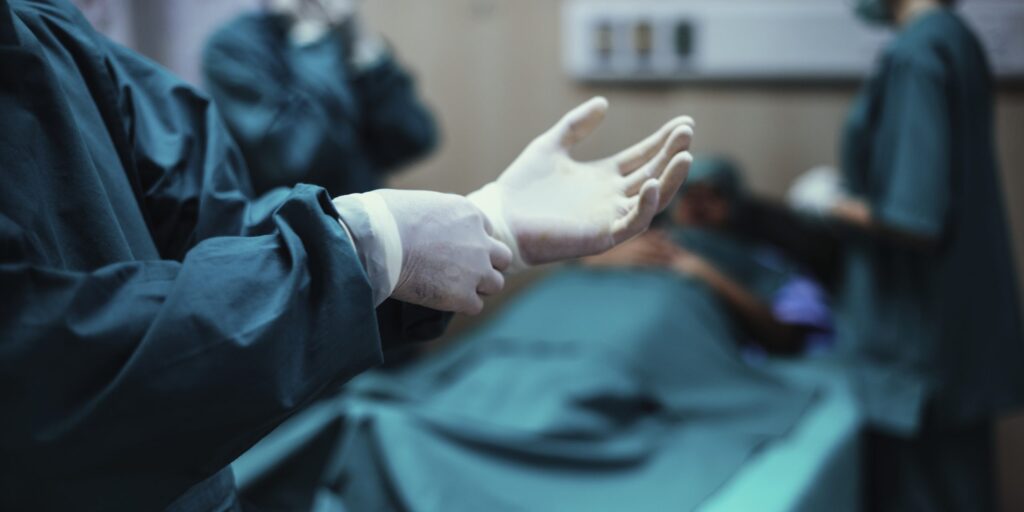
Being in the OR is a definite learning experience. After appeasing the circulating nurse, there’s the scrub nurse. I try my best to not touch or bump anything I shouldn’t, dodging tables and trays and movie machines. I’m also working on introducing my role confidently, retrieving my gloves, scrubbing in a timely manner, and not stepping on anybody’s toes, literally and figuratively.
As a medical student, my role during a case is mostly holding a retractor, standing very still, and trying hard not to ruin the sterile field. Sometimes I listen to the attending surgeon and the residents gossip and banter. Other times I’m taken by surprise by a pimp question or teaching moment here and there. The transplant cases can take hours, and it is an exercise in patience. It’s fascinating, however, to have a front-row seat as the surgeons anastomose vasculature and implant a new organ into the recipient. I’m always in awe of the precision and expertise.
Once the difficult part is over, the attending usually leaves and allows the fellow and resident to “close,” i.e. sew the patient up. Sometimes if I’m lucky, I’m allowed to throw a few stitches. Be wary of time when doing this—there are additional constraints of turning over the OR for the next case and minimizing patient exposure to general anesthesia. Practicing knots at home will make everything run smoother when the opportunity arises.
Evenings
Depending on the case, the day can definitely run late. The longest day I ever had was probably 3 a.m. to 7 p.m., but it was an outlier. If cases finish earlier, the students may leave a little earlier. Most days, I left around 4 p.m., as the team does keep the early wake-up times in mind.
My two weeks on this rotation were definitely exhausting. Keeping in mind that I had the surgery shelf exam to study for, I would usually have the bandwidth for 10 to 20 practice questions per day. Most of my studying was accomplished on my day off, which was one in seven.
During my transplant surgery rotation, I remember primarily focusing on sleep and feeding myself. I was essentially in survival mode. However, the experiences I got from this rotation were unparalleled and will stick with me forever. It takes a special kind of person to be a surgeon and being able to witness this firsthand as a student was definitely an opportunity I won’t forget.
Mike is a driven tutor and supportive advisor. He received his MD from Baylor College of Medicine and then stayed for residency. He has recently taken a faculty position at Baylor because of his love for teaching. Mike’s philosophy is to elevate his students to their full potential with excellent exam scores, and successful interviews at top-tier programs. He holds the belief that you learn best from those close to you in training. Dr. Ren is passionate about his role as a mentor and has taught for much of his life – as an SAT tutor in high school, then as an MCAT instructor for the Princeton Review. At Baylor, he has held review courses for the FM shelf and board exams as Chief Resident. For years, Dr. Ren has worked closely with the office of student affairs and has experience as an admissions advisor. He has mentored numerous students entering medical and residency and keeps in touch with many of them today as they embark on their road to aspiring physicians. His supportiveness and approachability put his students at ease and provide a safe learning environment where questions and conversation flow. For exam prep, Mike will help you develop critical reasoning skills and as an advisor he will hone your interview skills with insider knowledge to commonly asked admissions questions.
Congratulations on making it to clinicals! It’s been a challenging road thus far. You’ve endured hours of lectures, anatomy labs, and the colossal hurdle of Step 1. Now, you have the opportunity to take everything you’ve learned over the past two years and apply it to “the real world,” so to speak.
I remember the majority of my classmates feeling excited about starting clinical rotations. Though I understood the appeal, I dreaded losing my freedom and having a set schedule. As a medical student embarking on the clinical journey, you finally get a taste of what you’re training for: connecting with patients, treating illnesses, working as part of a medical team, and being involved in the medical decision-making process. Essentially, you get to see how the sausage is made and contribute in a meaningful way. Clinicals also present a unique opportunity to experience multiple specialties and ultimately discover the best fit for your eventual residency choice.
With that said, clinical rotations also have real stakes: you’re just as capable of doing good as you are of doing harm, even as a medical student. Moreover, your performance during clinical rotations can shape the trajectory of your career by closing some doors and opening others.
Put your knowledge to the test with this FREE shelf exam practice quiz of the most commonly missed shelf questions from the Rosh Review Shelf Exam Qbanks (one for each specialty)! Each question includes a detailed explanation and visuals to help you retain anything you may have missed. How many questions can you get?
My Experience as a Medical Student: Clinical Years
It’s hard to capture a singular, universal clinical experience because every rotation is unique. However, there are some commonalities I’ve found from my own experience.
You’ll work hard and have significantly less free time compared to preclinicals. Usually, I worked 8-15 hour days, about 5-6 days per week.
You’ll have shelf exams to study for in addition to your clinical duties during your core rotations. It’s fast-paced: once you get the hang of things for your current rotation, it will be time for a new rotation!
During your rotations, you’ll find yourself in awkward, difficult, and sometimes surreal situations. You’ll also learn how to take feedback. Spoiler alert: unless you’re a rockstar, it won’t always be glowing, and that’s okay.
Keep in mind that every institution is different and that the rotation experience even within the same specialty can vary wildly between students. However, I hope my experience can give you some insight into what to expect on your clinical rotations. Here is a day in my life during one of the most important clinical rotations of medical school: internal medicine.
Mornings
I wake up bleary-eyed at 5:45 a.m. It’s still dark out, and I roll out of bed in order to try to make it to the hospital by 6:30 a.m. I hop on the 6:07 a.m. bus after hastily washing up and getting dressed. The interns are already there by 6:00 a.m. to receive sign-out from the night team, but the upper level has mercy, allowing us a later arrival.
Our inpatient team consists of two students, two first-year residents (aka interns), and an upper level (a PGY-2 or PGY-3). Sometimes there will be a sub-internship student with us. Each student follows anywhere from three to five patients from our team list, usually assigned by the upper level.
Every morning, we enter the small team room and receive overnight updates from the intern. First, I log into the computer, print my list, chart review my patients, and prepare my progress notes. I try to keep chart review to under 20 minutes so that I have time to pre-round on my patients prior to the morning report, which starts at 7:30 a.m. Then, I run upstairs to pre-round on my patients and debrief with the resident after.
By the time the morning report comes along, I’m starving. Luckily, there are free bagels, in addition to the learning case presented by one of the inpatient residents. The morning report is our version of House, MD. Everyone follows along with an interesting case and attempts to make a correct diagnosis based on the initial presentation and lab/imaging data. Afterward, we return to our respective team rooms and wait for our attending physician to start rounding.
Rounds
Rounds start at 9:00 a.m. and usually last two to three hours, depending on patient volume and complexity, as well as attending preference. As we walk room to room, the residents efficiently present their patients, and afterward, we gather around the patient to answer questions, perform a physical exam, and discuss the plan for that day.
When we get to “my” patient who has cirrhosis, I timidly start to present. Staying on script and communicating only the essentials in a SOAP format is definitely a work in progress, especially as a green medical student!
The attending interrupts to ask me questions about the causes of liver failure and the recommendations regarding the treatment of spontaneous bacterial peritonitis. Luckily for me, the intern and I discussed the medicine regarding my patient. I answer, and, satisfied with my reply, the attending gives me a pat on the back and we move on.
If I didn’t know the answer, that usually means I’ve scored myself a 10-15 minute presentation on the topic in question to be delivered to the team later in the week. As we round, the superhuman interns run around arranging discharges, calling consultants, answering pages, and generally being in multiple places at the same time. I’m suddenly grateful I have the chance to learn without having to bear that much responsibility.
Afternoons
Today is Friday, so we aim to finish by noon for protected lecture time. (Plus, more free food if we’re lucky! Free food is the lifeblood of a medical student.) Sometimes we have patients left to see, and we make plans to meet after didactic hour. This can complicate the schedule because most days our team is responsible for some form of admissions or another.
During my training, we followed an 8-day cycle of admissions, alternating between long call, midday call, and short call. Today, we are on long call, which means that after 12 p.m. we start taking admissions until 6 p.m., up to six new patients with a potential seventh ICU transfer. The students usually take on one to two new admissions each. These are one of the best learning opportunities, as we have the chance to get to know the patient from admission to discharge, and we’re able to come up with our own care plan. New admissions are difficult and take a significant portion of time, so be prepared.
Before new pages come, I try to complete my progress notes on our existing patients. Students can’t sign notes, but we can pend them for the residents to review with our EMR system. If it’s a slow day, our residents sometimes ask for help with various tasks, such as following up with the social worker, updating the list, or going to ask the patient or family additional questions.
Sometimes the upper level or attending will give a 15-minute chalk talk teaching session on a topic of our choice. Then there are days when the afternoon is spent having difficult conversations with the patient and the patient’s family, often regarding goals of care or a sobering update on prognosis. These days were often the hardest.
Admissions Days
On admissions days, the residents accept the admissions and assign a patient to me. From there, I look through the vitals, labs, ER notes, and notes from previous admissions. I prefer to systematically organize my thoughts before presenting the new patient to the team, so I use a guided H&P form. The resident and I go down to the ER to observe me performing a history and physical exam. As I go through my H&P with the patient, the resident steps in occasionally to ask follow-up questions, or to get their own exam findings.
After the encounter, we discuss our thoughts on the patient and what the plan should be. When we’re happy with what we have, I present the patient to the attending, and we finalize our plan as the resident places admission orders in the EMR. This is another good opportunity for teaching, and oftentimes the attending includes some clinical pearls pertinent to the patient’s diagnosis.
The residents continue taking admissions while the students work on our admission notes. I’m still working on improving my efficiency, so the note can definitely take me a while. If the resident is not too busy, they will review the note and provide helpful feedback. If it gets to be too late and close to sign-out, the residents make plans to review the note with us on a further date. The students are usually free to go by 6 p.m. on an admissions day, and earlier on a non-admissions day (closer to 4:30 p.m. or 5 p.m.).
Evenings
I take the bus home and reflect on the day. Clinical rotations are definitely harder than my pre-clinical days, and there’s definitely more to the balancing act than before. I know that even at home, I have more preparation to do for the next day, as well as studying for my eventual internal medicine shelf exam. There are thousands of practice questions in order to prepare for the internal medicine shelf, and many things I still don’t know. For dinner, I’ll usually cook a quick meal or order take-out, hunkering down to study more or work on my upcoming presentation.
I make a goal for myself of finishing at least 50 practice questions per day, but it doesn’t always happen, especially on busy clinical days. Weekends and days off are my heavy-duty study days. I aim to sleep early because I know I have another early wake-up call tomorrow. Luckily, tomorrow won’t be an admissions day, and I’m looking forward to more teaching in the afternoon and getting to connect more with my team. Tomorrow is another chance to learn and grow, just another step further toward realizing my dream to be a doctor.
Mike is a driven tutor and supportive advisor. He received his MD from Baylor College of Medicine and then stayed for residency. He has recently taken a faculty position at Baylor because of his love for teaching. Mike’s philosophy is to elevate his students to their full potential with excellent exam scores, and successful interviews at top-tier programs. He holds the belief that you learn best from those close to you in training. Dr. Ren is passionate about his role as a mentor and has taught for much of his life – as an SAT tutor in high school, then as an MCAT instructor for the Princeton Review. At Baylor, he has held review courses for the FM shelf and board exams as Chief Resident. For years, Dr. Ren has worked closely with the office of student affairs and has experience as an admissions advisor. He has mentored numerous students entering medical and residency and keeps in touch with many of them today as they embark on their road to aspiring physicians. His supportiveness and approachability put his students at ease and provide a safe learning environment where questions and conversation flow. For exam prep, Mike will help you develop critical reasoning skills and as an advisor he will hone your interview skills with insider knowledge to commonly asked admissions questions.